Necuvintele de Nichita Stănescu

"El a întins spre mine o frunză ca o mână cu degete.
Eu am întins spre el o mână ca o frunză cu dinţi.
El a întins spre mine o ramură ca un braţ.
Eu am întins spre el braţul ca o ramură.
ca un măr.
Eu am inclinat spre el umărul
ca un trunchi noduros.
Auzeam cum se-nteţeşte seva lui bătând
ca sângele.
Auzea cum se încetineşte sângele meu suind ca seva.
Eu am trecut prin el.
El a trecut prin mine.
Eu am rămas un pom singur.
El
un om singur."
Din "Necuvintele" (1969)

"He offered me a leaf like a hand with fingers.
I offered him a hand like a leaf with teeth.
He offered me a branch like an arm.
I offered him my arm like a branch.
like a shoulder.
I tipped my shoulder to him
like a knotted trunk.
I could hear his sap quicken, beating
like blood.
He could hear my blood slacken like rising sap.
I passed through him.
He passed through me.
I remained a solitary tree.
He
a solitary man."
****

Arhiva foto privată/ Private photos archive.
Click to see enlarged views.


Arhiva foto privată/ Private photos archive.
Click to see enlarged views.
Series of photo instants,
up-close & collages in color and/or black & white.
Visions. April, 2016. Spring.
GândCălător.blogspot.com
Source of video: You Tube/ Internet
From Did You Know Category:
From around the web/media this week*
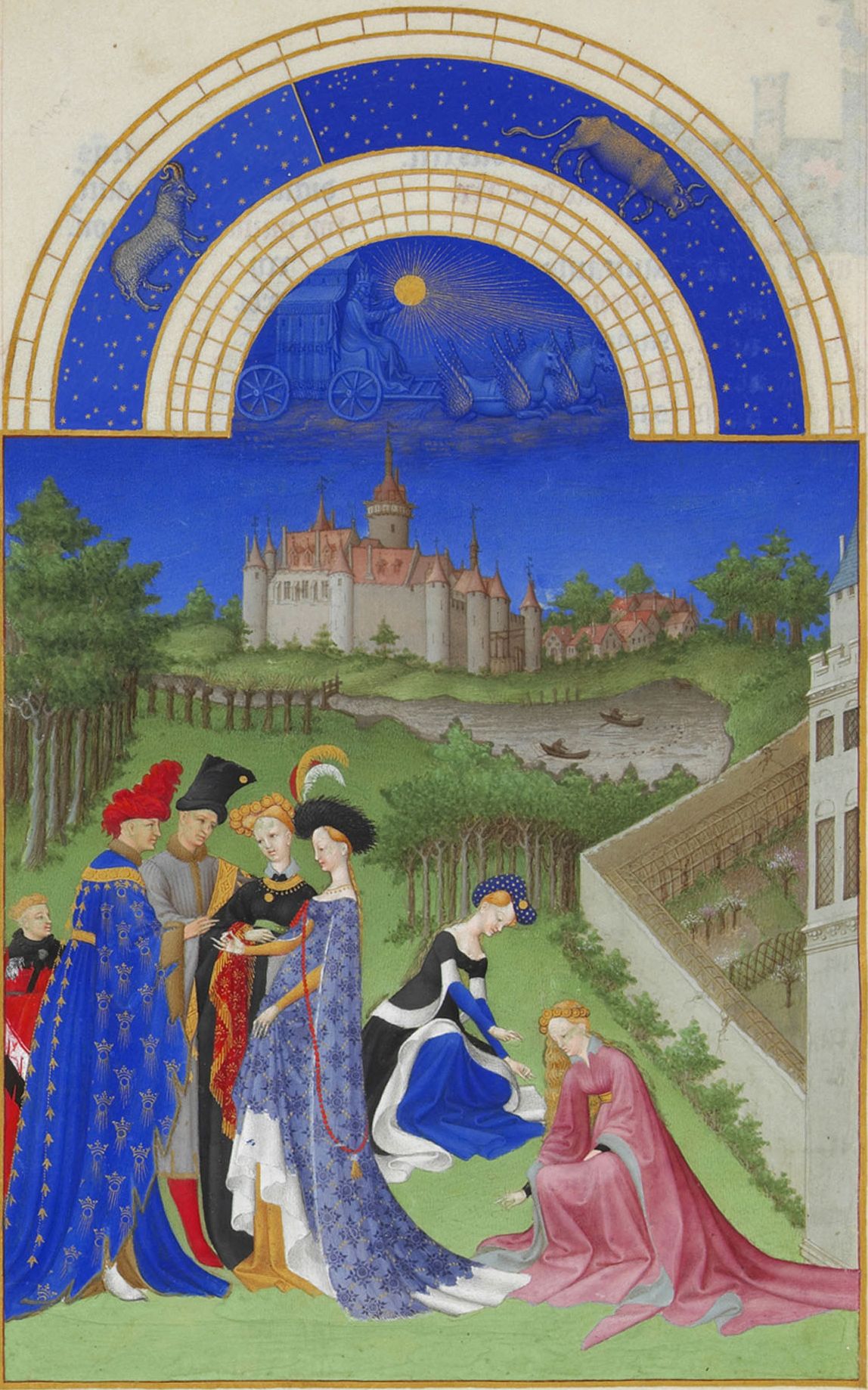 |
| Les Très Riches Heures du duc de Berry, Avril the Musée Condé, Chantilly. April; between 1412 and 1416 Limbourg brothers [Public domain], via Wikimedia Commons |
Grecii numeau luna aprilie Mounichion. În România, luna aprilie, popular, se numeşte Prier."
"April* is the fourth month of the year in the Gregorian calendar, the fifth in the early Julian and one of four months with a length of 30 days.
The Romans gave this month the Latin name Aprilis but the derivation of this name is uncertain. The traditional etymology is from the verb aperire, "to open", in allusion to its being the season when trees and flowers begin to "open", which is supported by comparison with the modern Greek use of άνοιξη (ánixi) (opening) for spring. Since some of the Roman months were named in honor of divinities, and as April was sacred to the goddess Venus, her Veneralia being held on the first day, it has been suggested that Aprilis was originally her month Aphrilis, from her equivalent Greek goddess name Aphrodite (Aphros), or from the Etruscan name Apru. Jacob Grimm suggests the name of a hypothetical god or hero, Aper or Aprus." *click to read more about on Wikipedia.
About Lilac/Liliac

"Syringa vulgaris (lilac or common lilac)* is a species of flowering plant in the olive family Oleaceae, native to the Balkan Peninsula, where it grows on rocky hills. This species is widely cultivated as an ornamental and has been naturalized in other parts of Europe (UK, France, Germany, Italy, etc.), as well as much of North America. It is not regarded as an aggressive species, found in the wild in widely scattered sites, usually in the vicinity of past or present human habitations."
Description
Taxonomy and naming
Syringa vulgaris was first formally described by Carl Linnaeus in 1753 and the description was published in Species Plantarum. The specific epithet (vulgaris) is a Latin word meaning "common" or "usual".
Liliacul sau Syringa vulgaris *"face parte din familia oleaceelor şi este o specie din genul Syringa care înfloreşte primăvara. Este un arbust a cărui înălţime poate ajunge până la şapte metri, cu ramuri drepte şi lujeri puţin muchiaţi.
Florile sunt simple sau duble, plăcut mirositoare, grupate în penicule de până la 20 cm lungime, multiflorale, în culori diferite, de la liliachiu la alb. Floarea are caliciul mic, campanulat, cu patru dinţi, corolă cu tub de un centimetru lungime, cu patru lobi patenţi şi două stamine.
Utilizare
Creşte în tufişuri, în sălbăticie, dar este mai ales cultivat ca arbust ornamental.
Liliacul are şi proprietăţi medicinale. În acest scop se recoltează frunzele, din care se prepară infuzie sau comprese."
*Click to read more info on Wikipedia.
****
****
About GALAXIES
 |
| An artist’s impression of a supermassive black hole occupying the center of a distant galaxy. ZHAOYU LI (SHANGHAI ASTRONOMICAL OBSERVATORY)* |
Excerpts: "Astronomers have found a monster black hole, some 17 billion times more massive than the sun, in a modestly sized galaxy, raising suspicions that supermassive black holes may be much more common than originally thought.
Previously, all known supermassive black holes were found in very large galaxies that are clustered in large groups of galaxies."
"Black holes are regions so packed with matter that not even photons of light can escape the gravitational warping of space.
The largest black hole found so far is about 21 billion times more massive than the sun. In comparison, the black hole at the center of the Milky Way galaxy, named Sagittarius A, is about 4 million time the mass of the sun.
The newly discovered black hole is in a somewhat isolated and average-sized galaxy known as NGC 1600. It was studied as part of an ongoing survey of the 100 most massive galaxies within about 300 million light-years from Earth."
*Sursa/Source of picture/article above: click to read more info on Discovery News
****
About Animal Communication on National Geographic
NEWS: The Science of Meow: Study to Look at How Cats Talk
"March 28, 2016 - Do you know what your cat is saying when it meows at you? Researchers in Sweden are trying to give us a better idea by identifying melodic patterns in cat meows: Is your cat hungry or really hungry? Additionally, the way you talk to your cat may influence how your cat talks back. By comparing cat speech in two regions in Sweden where people speak separate dialects, researchers will determine whether cats in different regions also have different cat "dialects." With the number of cats living as pets worldwide estimated in the hundreds of millions, the research may help cats and humans communicate better."* Click to read more info on the link below:
What Are Cats Trying to Tell Us? Science Will Explain
Excerpts: So why do cats meow anyway?
Cats use both visual and vocal signals to communicate with humans, but they need to vocalize to get our attention. With other cats, they tend to rely on visual and olfactory signals. When a cat says “meow,” it’s normally addressed to a human being, not another cat. (See "What Do Cats Think About Us? You May Be Surprised.")
"Write it on your heart
that every day is the best day in the year.
He is rich who owns the day, and no one owns the day
who allows it to be invaded with fret and anxiety.
Finish every day and be done with it.
You have done what you could.
Some blunders and absurdities, no doubt crept in.
Forget them as soon as you can, tomorrow is a new day;
begin it well and serenely, with too high a spirit
to be cumbered with your old nonsense.
This new day is too dear,
with its hopes and invitations,
to waste a moment on the yesterdays.*"
*Source Internet:
By Ralph Waldo Emerson in "Collected Poems and Translations".
Happiness starts with yourself.

 Source of quotes: Daily Vibes; Lessonslearnedinlife.com
Source of info: Wikipedia, Discovery News, National Geographic; public e-media/internet.


Source of info: Wikipedia, Discovery News, National Geographic; public e-media/internet.
Gladly shared with:
Be joyful, amazing and never give up to smile!
Stunning things are all over!
Stay positive, today, tomorrow and always!
Rămâi pozitiv, astăzi, mâine și întotdeauna!
So, very thankful, each and every day, to be inspired...
All is well...